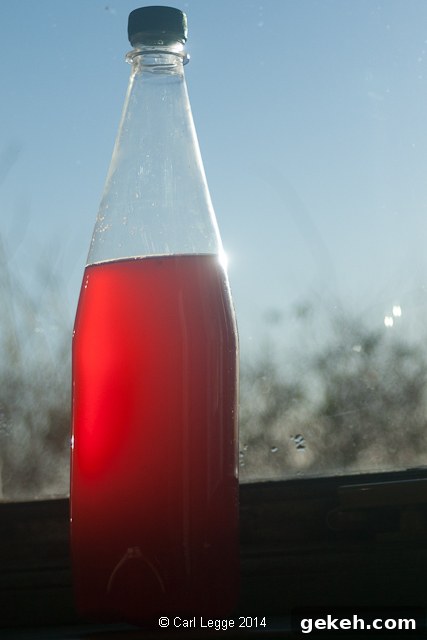
If you want a sparkling drink with exceptional flavour, this currant “champagne” recipe delivers. In under a month you’ll have bright, fruity currant flavour with a pleasant tart-tannin edge and the fresh green aroma of crushed currant leaves, all wrapped in lively fizz. It’s one of my favourite quick fizz discoveries.
I had a freezer full of mixed red, black and white currants and wanted to free up space. Having enjoyed fast elderflower “champagne” in spring, I decided to experiment with currants using a similar approach.
It worked very well.
Read on to learn how straightforward this method is and how you can adapt it to other fruits.
Currant “champagne” recipe
The quantities below yielded about 20 litres of finished wine. The recipe scales easily, and small variations in fruit quantities won’t dramatically affect the result.
This method works with most soft fruits and foraged berries — bilberries, blackberries, damsons, mulberries, rose hips, sloes and the like can be used alone or in combination.
I describe exactly what I did so you can adapt the steps to the fruit and equipment you have.
Principles
The basic principles for making this style of wine are simple:
- soften the fruit;
- extract flavour and colour;
- allow the primary fermentation to proceed until it is nearly finished;
- strain and bottle;
- allow a short secondary fermentation in the bottle to produce fizz and a bit more alcohol;
- rest briefly and then enjoy.
Ingredients
This is what I used from my freezer, giving roughly 250–300 g fruit per litre of finished wine.
Red currants 3.2 kg
Black currants 1.7 kg
White currants 0.8 kg
Total fruit 5.7 kg
Sugar is added in stages:
Granulated sugar A 3.0 kg
Granulated sugar B 1.5 kg
Granulated sugar C 1.0 kg
Total sugar 5.5 kg
Plus:
- pectic enzyme (helps break down pectin and aids clearing and juice extraction);
- yeast nutrient (follow your brand’s directions — as a home substitute you can use 1 tsp Marmite, yeast extract or malt syrup dissolved in a little hot water);
- general-purpose wine yeast (follow packet instructions for dosage).
Method
Equipment
Use a fermentation bucket or bowl that holds more than the final wine volume (having two buckets makes straining and bottling easier). Some headroom is important in case fermentation becomes vigorous.
A plastic colander and a funnel with a built-in sieve are useful; improvise if needed. If you plan to make still wine as well, a demijohn (or demijohns) with an airlock and siphon tubing will be required to finish fermentation in a closed container.
You’ll also need stirring spoons, a saucepan, long-handled ladles, and basic kitchen items. For sparkling bottles, we use used 2-litre cola bottles and strong plastic 1-litre bottles designed to take pressure. Do not use ordinary glass wine bottles for these sparklers — they can explode under pressure and cause injury.
Sanitise all equipment thoroughly before use with a suitable homebrew steriliser solution.
How to make the wine
Frozen fruit is easiest to work with because freezing breaks down cell walls, making crushing simpler. Defrost the fruit — ours thawed overnight (about 18 hours).
Crush the thawed fruit in a clean fermentation bucket.
Dissolve Sugar A (3 kg) in a large saucepan with about 2 litres of water. Heat and stir until fully dissolved, then pour over the mashed fruit and mix thoroughly. Top up the bucket with water until you have about 10–12 litres of liquid.
If you plan to use pectic enzyme, make sure the must (fruit liquid) is at or above warm room temperature (around 20°C) so the enzyme works effectively. Add the pectic enzyme following the packet directions, stir, cover with a lid or a clean cloth secured with an elastic band, and leave for 24 hours in a warm spot.
Dissolve Sugar B in about a litre of hot water, add to the bucket and stir. Top up with water until the total volume is roughly 20 litres. Add yeast nutrient and the wine yeast according to the manufacturer’s instructions. Stir well, cover, and keep in a warm place (ideally around 20°C) to ferment.
Fermentation can take a day or two to start. Stir the must daily to re-submerge floating fruit solids and to incorporate air, which helps extraction and yeast activity.
After about a week the fermentation should be calming. A hydrometer reading around SG 1010–990 and stable indicates most sugar has been converted. If you taste the liquid you should still notice slight bubbles — a sign the fermentation is still active and ready for the next step.
Prepare clean, sturdy bottles and lids for the sparkling wine, or a clean demijohn and airlock if you plan to make still wine.
Strain the liquid from the fruit solids. If possible, strain into a separate clean bucket using a colander over a funnel with a sieve to prevent clogging. Carefully ladle or pour the liquid through this setup, leaving sediment and gunky solids behind. Tilt the fermentation bucket gently at the end to get most of the liquid out without disturbing the sediment. Discard or compost the leftover fruit solids.
Add Sugar C to the strained liquid and stir until dissolved. Transfer or siphon the wine into the prepared bottles, leaving about 5 cm of headspace. Before sealing, squeeze the bottle sides briefly so the liquid rises close to the neck, then screw the lid on tightly. The slight compression leaves room for CO2 from the secondary fermentation to expand before the bottle becomes fully pressurized.
I kept about 5 litres in a demijohn to finish as still wine and bottled the remainder for sparkling.
Store the bottled wine in a warm place for at least 7–10 days to allow the secondary fermentation to carbonate the wine and raise the alcohol slightly. You’ll notice bottles firming as they pressurise; check for leaks and tighten lids if needed. If any bottle seems overly stressed, carefully release a little gas by slightly cracking the lid, then retighten. Over time the wine will clear as sediment settles.
How to open the wine — carefully!
Chill bottles in the refrigerator for several hours before opening. Open very gradually: crack the lid slightly to let gas escape, then close and allow the contents to settle. Repeat this a few times until you can safely open the bottle. If you open too quickly the wine will froth and may overflow, taking sediment with it. Once settled, pour and enjoy the fresh, fruity fizz.
Let me know how your batch turns out.