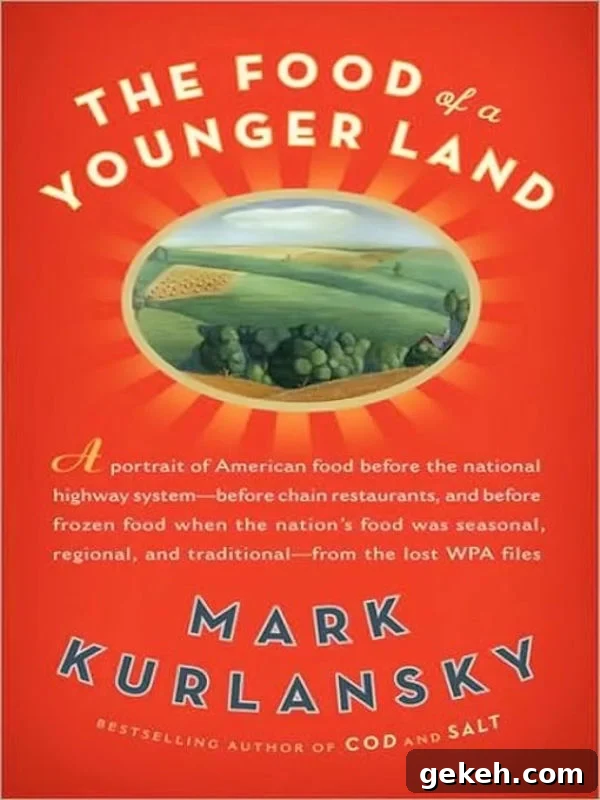
Mark Kurlansky’s: The Food of a Younger Land
I recently finished reading Mark Kurlansky’s The Food of a Younger Land and was struck by how dramatically American food changed over the past eighty years. Most readers know about major New Deal programs like the CCC and the WPA, but a lesser-known initiative, the Federal Writers’ Project (FWP), produced a trove of regional manuscripts. After compiling state and regional guidebooks, the FWP began a larger project called America Eats. That effort was never completed: manuscripts were shelved when World War II intervened.
Kurlansky discovered those stored papers and, with careful editing and contextual introductions, crafted a book that opens a window onto the food, recipes, customs, and regional perspectives of the United States roughly a decade or two before widespread refrigeration, interstate highways, and national restaurant chains changed daily life. The material feels immediate and local: most Americans then lived in small towns or rural areas, and suburban life as we know it did not yet exist.
Ingredients
A concise portrait of the common pantry of the era reveals staples such as cornmeal, pork and pork fat, beans, molasses, salt, butter, black pepper, cloves, allspice, cinnamon, pickled vegetables, and canned tomatoes. Cornmeal in particular was far more central to everyday cooking than I had realized—used in breads, porridges, dumplings, and many regional preparations.
Stews
Stews featured prominently in daily meals. They were practical, nourishing, and convenient: a pot could be prepared ahead of time and stretched to feed many people. Reading first-hand accounts reinforced how central stews were to household economies and family dining, especially where resources were limited.
Meat
Americans ate a wide range of proteins—beef, pork, chicken, fish, shellfish, rabbit, and wild game—but consumption and availability varied by place and infrastructure. Cuts of beef common today were often tied to proximity to meatpacking centers and rail lines. Coastal communities ate seafood immediately after the catch because refrigeration was scarce. Game and small mammals remained important sources of protein in rural areas.
Cultural Attitudes
Kurlansky retained much of the original language from the WPA manuscripts, allowing readers to hear the voices and viewpoints of the 1930s authors without heavy modernization. That choice makes the book both illuminating and, at times, uncomfortable: it exposes period attitudes, regional dialects, and cultural assumptions in an unfiltered way. These passages offer valuable insight into how people of that era described one another and their communities.
Summary
The Food of a Younger Land is well worth reading. It taught me many historical facts I hadn’t known and clarified how food functioned as a social glue—bringing communities together for oyster roasts, debates over clam chowder styles, or mint juleps at social gatherings. The book traces the origins of dishes like hush puppies, explains regional food rituals, and preserves recipes that feel both simple and rooted in place. I plan to try a few of them; the real challenge will be following the originals closely and resisting the urge to modernize with extra herbs and spices.
Kurlansky has written other food-focused histories worth noting. Salt: A World History is another example of his ability to take a single ingredient and reveal its broad cultural and economic significance. He has also authored books on cod and oysters that explore similar intersections of food, history, and regional life.
Overall, the book is a vivid, readable collection that captures a moment when American foodways were shaped by locality, seasonality, and community—before industrial distribution and modern conveniences made many regional practices fade or transform.